REPEATER
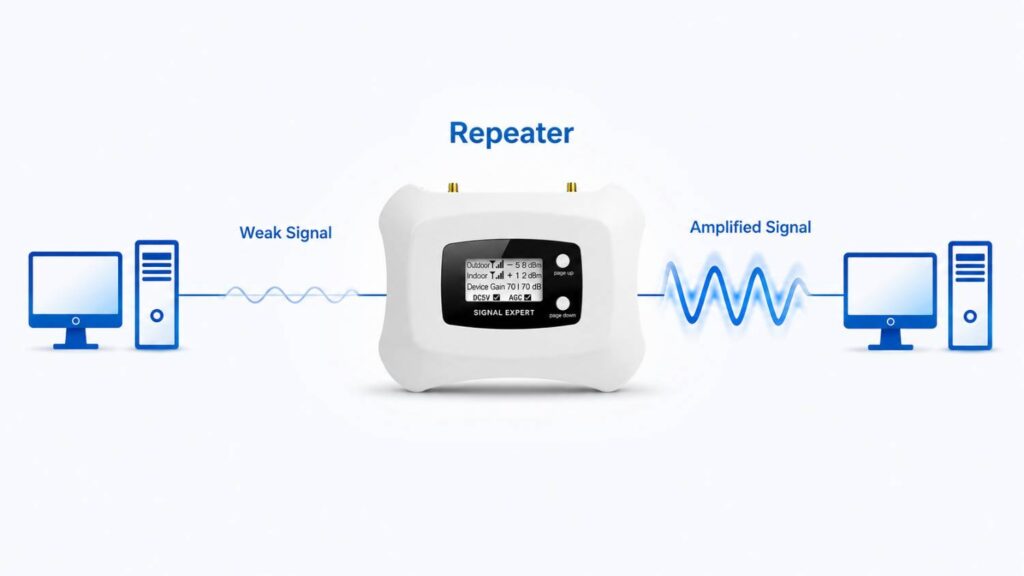
Repeaters are devices used in wired and wireless networks that are responsible for amplifying and regenerating signals weakened over long distances. This increases the network range without creating a new network and without requiring a separate username and password.
Repeaters operate at the physical layer of the OSI model and, by amplifying the signal, compensate for quality degradation caused by distance, interference, or obstacles. This helps reduce errors, prevent data loss, and ensure reliable information transmission. Repeaters are considered active network equipment; they receive a weak signal, amplify it, and retransmit it so that the signal reaches its destination with sufficient strength.
Key points:
Function: Receiving, amplifying, and retransmitting the signal.
Purpose: Extending network range and preserving signal quality.
OSI Layer: Layer 1 (Physical).
Main advantage: Error-free transmission over longer distances.
Difference from similar devices: Independent operation and no creation of a new network.
In addition to amplifying network signals, repeaters can also clean and regenerate the signal. In other words, any noise or distortion introduced during transmission is removed or reduced, resulting in a clearer and more reliable signal.
Repeaters are divided into the following two categories based on the type of signal:
1. Analog repeater: amplifies and retransmits analog signals. It is often found in older networks that use analog signals, such as traditional telephone networks.
2. Digital repeater: regenerates analog signals and removes noise, ensuring the transmission of clean data (data free from noise and errors). It is commonly used in modern computer networks that use digital signals.
Analog repeaters are only capable of amplifying the signal, whereas digital signal repeaters can regenerate the signal and restore it close to its original quality.
Difference between Repeater and Extender:
Repeaters and Extenders are two different devices used to increase the range and coverage of a wireless network and amplify the signal. However, an Extender expands wireless coverage, while a Repeater simply repeats the signal.
An Extender is a device that connects to an existing network and rebroadcasts the signal to extend the network's range. This device creates a new network name (SSID) and a new password, so devices connected to the Extender are on a separate network from the main router. Therefore, when moving around your home or office, you must manually switch between the main network and the Extender network.
A Repeater is a device that connects to an existing network and rebroadcasts the signal without creating a new network name or password. This device acts as a bridge between the main router and the devices connected to it, thereby extending the network's range. Since it does not create a new network, devices can seamlessly move between the main router and the Repeater without the need for manual switching between networks.
Difference between Repeater and Router:
A router is a network device that connects multiple devices to a single internet connection. It acts as a central hub, directing traffic between devices and the internet. Routers have network security features, firewall protection, and the ability to create a local area network (LAN) for devices to communicate with each other.
A repeater receives, amplifies, and rebroadcasts the wireless signal from the router to increase the coverage area. A repeater does not create a separate network and lacks additional features like routers; it merely extends the range of the existing network.
Thus, repeaters in a data network can transfer messages between subnets using different protocols or cable types, but they are not capable of the intelligent routing performed by bridges and routers. Ultimately, unlike a repeater which only amplifies the signal, a router is responsible for routing data within the network.
Difference between Repeater and Hub:
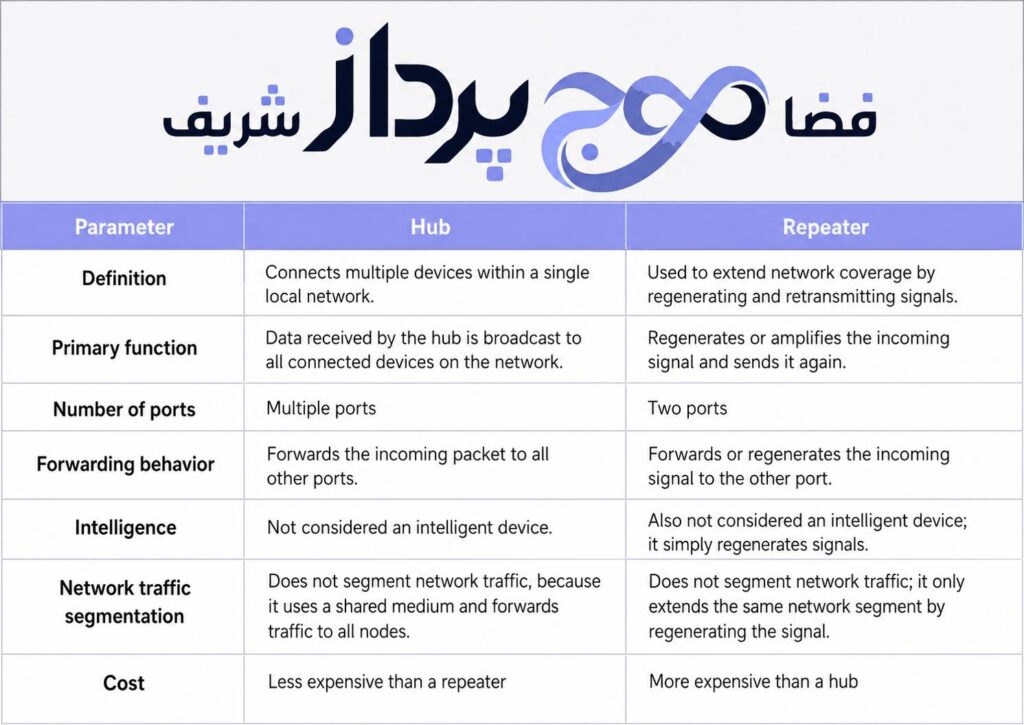
How network traffic is processed: A repeater regenerates and amplifies the network signal, while a hub sends incoming data to all devices connected to the network.
Difference in function: A repeater is used to increase the range of the network signal, while a hub is used to connect multiple devices to each other and create a local network.
Network traffic segregation: A repeater does not segregate network traffic and does not create a collision domain. However, a hub shares the same collision domain with all connected devices, creating a single collision domain. When a device connected to a hub sends data, all devices connected to the hub receive this data, which can lead to data collisions and network congestion. Both repeaters and hubs transmit signals, but their applications differ.
Difference Between Repeater and Access Point:
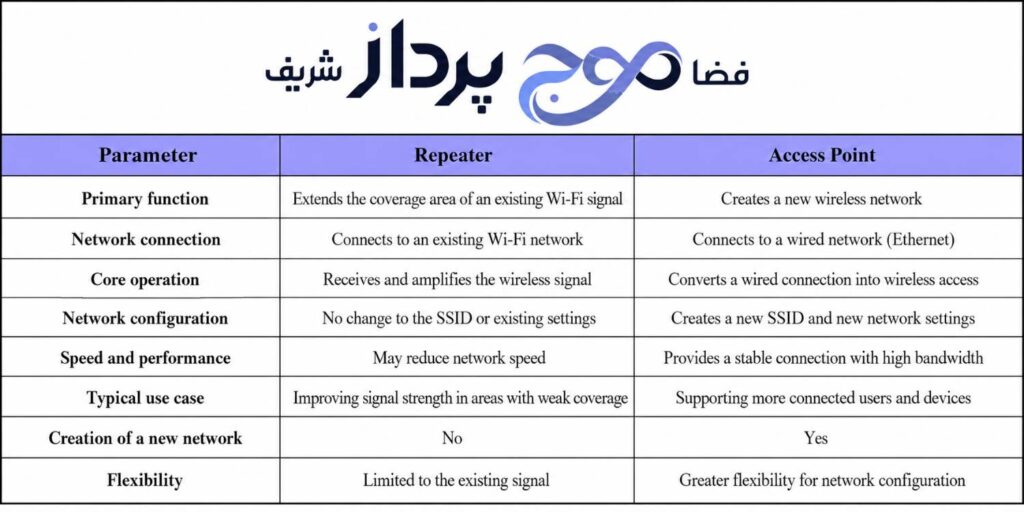
The best choice between a Repeater and an Access Point depends on your business needs. Let’s see what the difference between a Repeater and an Access Point is. Are you looking to extend WiFi coverage for your guests and customers? If so, a wireless access point will be the most reliable internet source for your staff and customers, and it can handle a larger number of devices.
A Repeater is a good option for small businesses with a limited number of internet users. This device can amplify the signal to improve internet coverage throughout the office or workspace.
The drawback of Access Points is the installation process. Setting up cables and routing them through walls and ceilings is not always possible. A Repeater provides wider coverage, but it reduces internet speed. Depending on your use case, this may be acceptable, but if high-speed internet connectivity is essential for your business, an Access Point can be the best solution.
When deciding between a Repeater and an Access Point, you should consider how many devices each option can support. A Repeater is limited by the capacity of the main router and must still have enough bandwidth available for use. So, it may be suitable for a home, but it can quickly become unstable in a business environment, especially if customers connect to your public WiFi access point. To extend WiFi coverage, both Repeaters and Access Points are used.
Difference Between Repeater and Bridge:
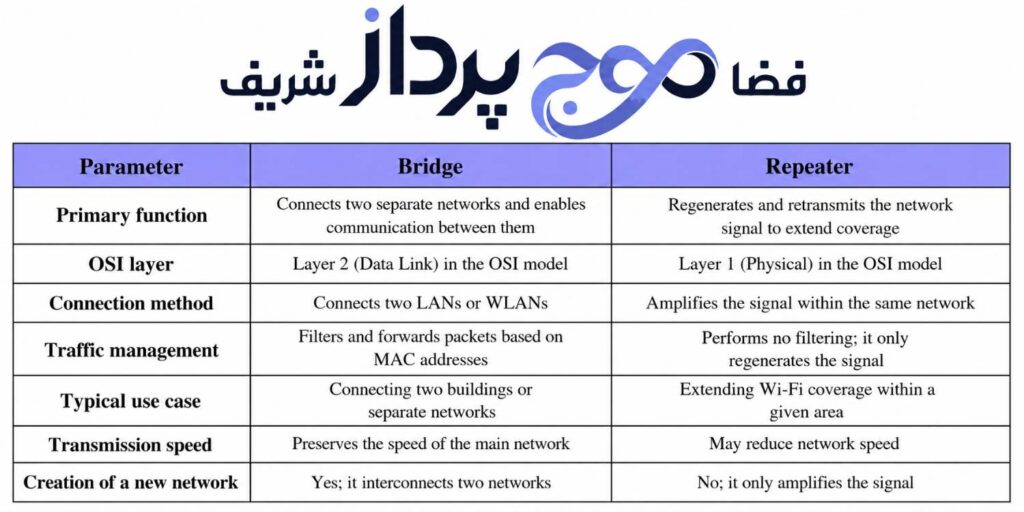
If neither a repeater nor an access point is suitable for you, there is a third way to improve your network: a Bridge. Let’s see what the difference between a Repeater and a Bridge is.
A Bridge system is a method for connecting two routers to a single local area network. Two adjacent buildings belonging to one business can benefit from the same Wi-Fi and local network. All you need to do is connect the two routers wirelessly.
The difference between a Bridge and a Repeater is that a Bridge connects two separate networks, and this connection allows them to act as a single network. A Bridge is used when a repeater is not enough or when setting up an access point is not feasible. Compared to a Bridge, a repeater has simpler functionality and operates at a lower layer.